In late March 1948, at a resort in Pennsylvania’s Pocono Mountains, a 29-year-old physicist drew lines on a blackboard and tried to explain how electrons move. Niels Bohr and Paul Dirac, two of the men who built quantum mechanics, were in the audience. Accounts differ in detail, but the outline is consistent: Bohr objected that the uncertainty principle forbids talk of particle trajectories, and the elder statesmen concluded that Richard Feynman did not understand the theory he was trying to extend.
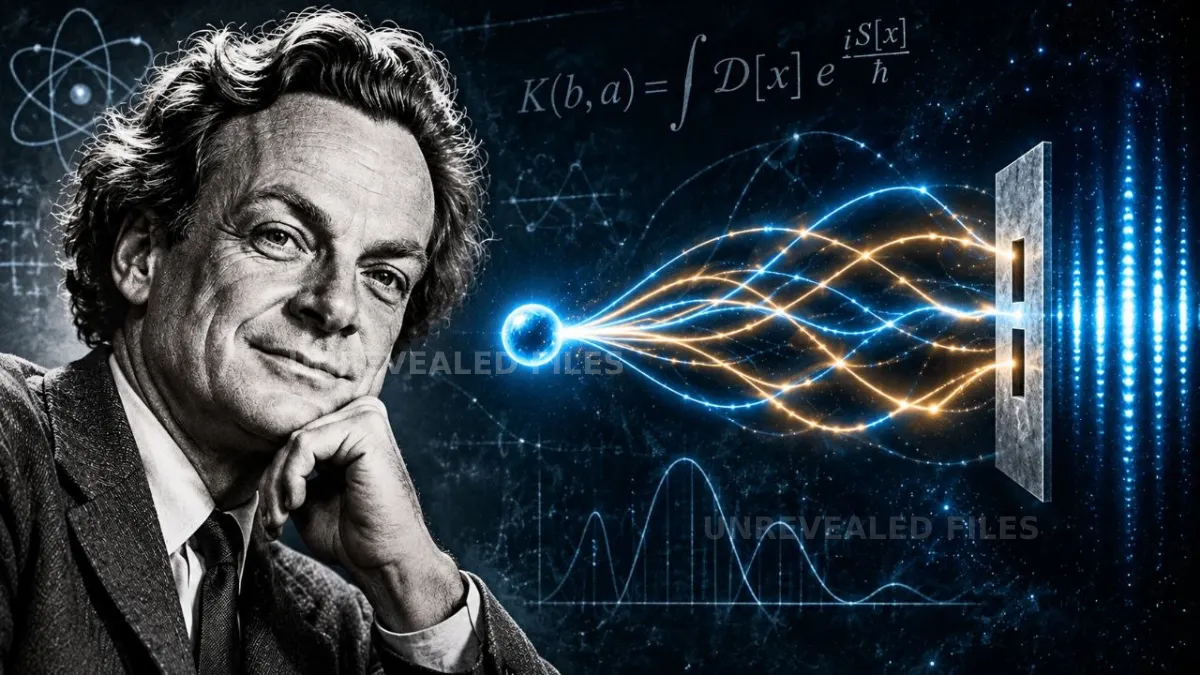
Those lines were the visible tip of a stranger idea. Feynman had found a way to calculate quantum behaviour by considering every way a particle could get from one point to another and giving each a contribution. Popular science compresses this into one sentence: the electron takes every possible path. The sentence is memorable, widely repeated, and, as a claim about what physically happens, much less secure than it sounds.
This investigation follows the idea from its origin, which was a failed attempt to repair classical electrodynamics, through the mathematics of the sum over paths and the experiments that test it, to the question underneath: is the path integral a description of reality, or a remarkably effective way of computing it?
Why Classical Physics Gives a Particle One Path
Classical mechanics is a physics of definite trajectories. Give Newton’s equations a ball’s position and velocity now and they return its position at every later moment: one path, no ambiguity.
There is a second, equivalent description. Developed through the eighteenth and nineteenth centuries by Maupertuis, Euler, Lagrange and Hamilton, the principle of least action assigns to every conceivable path between two points a number called the action, built from the particle’s kinetic and potential energy along the way. The path nature actually follows is the one for which the action is stationary, which in simple cases means a minimum.
The two languages say the same thing differently. Newton’s tells you what happens next, moment by moment. The action principle judges whole paths at once. Note a peculiar feature: it compares paths that are never taken. Classically, that comparison is a mathematical device and little more. Feynman’s insight was that in quantum mechanics the untaken paths become indispensable.
Why Quantum Mechanics Needed Something Different
In the 1920s atoms refused to behave like miniature planets. Heisenberg produced matrix mechanics in 1925 and Schrödinger a wave equation in 1926. Feynman’s 1948 paper opens by remarking on this curious history: modern quantum mechanics began with two very different-looking formulations that turned out to be equivalent.
Both describe a system step by step in time, and both give up definite trajectories. If position and momentum cannot both be sharply fixed, a path with an exact position and velocity at every instant loses its footing.
The double-slit experiment shows the consequence. Fire electrons one at a time at a barrier with two slits and each arrives at a single spot, yet after thousands of arrivals a banded interference pattern builds up. That pattern is not what you get by adding the results of two single-slit experiments. Quantum theory predicts it by assigning each alternative a complex number called an amplitude, adding the amplitudes, and only then squaring to get a probability. What those amplitudes mean physically has been argued over ever since.
A Failed Theory That Produced a Successful Method
The path integral did not begin as an explanation of the double slit. It began as an attempt to fix electrodynamics.
The problem was self-energy. An electron’s field acts back on the electron itself, and for a point charge the energy of that interaction comes out infinite. As Feynman recounted in his 1965 Nobel lecture, he decided as an MIT undergraduate that the simplest cure was to forbid self-interaction altogether: electrons should act only on other electrons, with a delay. At Princeton, John Wheeler pointed out the flaw. Radiation resistance, the drag an accelerating charge feels as it radiates, seemed to require some self-action. The two then built a rival theory in which charges interact directly through a symmetric mix of forward-in-time and backward-in-time solutions of Maxwell’s equations. It needed no field at all.
There was a catch. The theory’s action depended on the positions of particles at two different times, and the quantum mechanics of the day ran on the Hamiltonian, a rule for how a system changes from one instant to the next. Feynman could not find a momentum variable to promote to an operator, because the theory did not have one. He needed a way to build quantum mechanics starting from an action.
Dirac’s Hint at a Beer Party
The opening came at a gathering at Princeton’s Nassau Tavern, where a newly arrived European physicist, Herbert Jehle, asked what Feynman was working on. Feynman described the problem. Jehle replied that Dirac had written a paper bringing the Lagrangian into quantum mechanics, and showed it to him in the library the next day.
Dirac’s 1933 paper, “The Lagrangian in Quantum Mechanics”, observed that the quantity carrying a wave function across a very short time step was analogous to the exponential of the classical action. Feynman asked what “analogous” was supposed to mean. Jehle, by Feynman’s telling, teased him for wanting a use for everything. Feynman set the two quantities equal, up to a normalising constant, expanded for small time steps, and the Schrödinger equation came out. Dirac had written “analogous”. Feynman had shown, for this class of systems, “proportional”.
Days later, lying in bed, he asked what happens over a finite time. Chain the small steps together. Each is an integral; the exponentials multiply into the exponential of a sum; as the steps shrink, that sum becomes the integral of the Lagrangian over time, which is the action. The wave function at a later time emerges as an infinite sequence of integrals over every intermediate position, each weighted by a phase set by the action. Feynman described the result as a third formulation of quantum mechanics, equivalent to Schrödinger’s and Heisenberg’s but looking nothing like them. Each possible way of getting from one point in space-time to another carries an amplitude, and the amplitudes add.
He wrote it up as his Princeton thesis, “The Principle of Least Action in Quantum Mechanics”. The war intervened. The mature statement appeared in 1948 as “Space-Time Approach to Non-Relativistic Quantum Mechanics” in Reviews of Modern Physics. Its abstract is blunt about status: the formulation is mathematically equivalent to the familiar one.
What Feynman Later Admitted
The Nobel lecture is unusually candid. Feynman said that most of the ideas he developed along the way were not used in the final result: the half-forward, half-backward interaction, the action he started from, the notion that charges do not act on themselves. The path-integral formulation, he said, helped him guess final expressions and recast electrodynamics in new ways, but strictly it was not necessary.
That corrects the way the idea is often sold. It was not a revelation about what electrons do. It was a new way of organising calculation that turned out to be extraordinarily productive.
How the Sum Over Paths Works
The rule can be stated without heavy mathematics. To find the amplitude for a particle to go from A to B:
- Consider every conceivable path from A to B, including straight ones, curved ones and wild zigzags.
- Work out the classical action for each.
- Give each path a small arrow of the same length, pointing in a direction set by the action divided by Planck’s constant (the reduced constant, ħ).
- Add all the arrows. The squared length of the total arrow is the probability.
Every path contributes equally in size. They differ only in direction.
Why a Thrown Ball Takes One Path
If all paths contribute equally, why does a cricket ball fly in a single parabola? The answer lies in the size of ħ, roughly 10⁻³⁴ joule-seconds. A ball’s action is of the order of joule-seconds, so its arrows rotate through something like 10³⁴ radians. Nudge the path slightly and the arrow swings wildly. Neighbouring arrows point every which way and cancel.
The exception is the neighbourhood of the path where the action is stationary. There, small changes in the path barely change the arrow’s direction, so the arrows line up and add. That is the classical path. The principle of least action reappears as the place where quantum arrows agree. For an electron in an atom, the action is comparable to ħ, the cancellation is far from complete, and many paths matter.
Feynman used the same arithmetic in his 1985 book QED: The Strange Theory of Light and Matter. Light appears to bounce off a mirror at a single point, yet in his treatment there is an arrow for a route via every point on the mirror. Only those near the geometric reflection point add up; the rest spin and cancel. Remove the strips of mirror where arrows would oppose the total and you have, in effect, built a diffraction grating.
The paths that dominate are not the smooth curves of school diagrams. In Feynman and Hibbs’s 1965 textbook Quantum Mechanics and Path Integrals, the typical contributing path is continuous but jagged, with no well-defined velocity at any instant. “Path” here is a mathematical object, not a trajectory in Newton’s sense.
The Double Slit, Rewritten as a Sum
Apply the rule to two slits. Paths from the source to a point on the screen fall into two families: those through slit one and those through slit two. Add the arrows within each family, add the two totals, then square. Whether the totals reinforce or cancel depends on where on the screen you look, and that produces the bands.
Now detect which slit the electron used. The rule changes. When observation distinguishes the alternatives, you add probabilities instead of amplitudes, and the bands vanish. Feynman’s 1948 paper identifies this as the essential difference between classical and quantum physics: where alternatives cannot be told apart, amplitudes add; where they can, probabilities add.
The consequence is easy to miss. The sum over paths describes the situation precisely when you do not know the path, and it stops applying when you find out. That is why no experiment can catch an electron “taking every path”. Looking changes the situation being described.
A Real Test: The Triple Slit
The framework does make one sharp, testable claim. Because probability is the square of a sum, interference arises only between pairs of alternatives. Add a third slit and there should be no new three-way interference term. This is a statement of Born’s rule, and in 1994 Rafael Sorkin suggested that generalised quantum theories might violate it.
In 2010, Urbasi Sinha and colleagues sent single photons through three slits and reported in Science that any three-path interference was below one per cent of the expected two-path effect. A 2014 theoretical analysis found that the contribution of exotic, looping paths in such an experiment could be around one part in a million of the central peak, far below what the 2010 setup could detect.
So the structure of the path sum has survived a direct test. What was tested, though, is the mathematics, meaning squared sums and pairwise interference. It was not literal travel along every route.
From Paths to Feynman Diagrams
Return to the Poconos. Julian Schwinger had just given a long, polished presentation of his own approach to quantum electrodynamics; Feynman followed with pictures. Bohr’s objection, as historians report it, was that the uncertainty principle rules out trajectories. According to a later analysis, Bohr acknowledged that the objection rested on a misconception, and Feynman never intended the lines as literal paths.
What the pictures encoded was a way of organising the calculation. Applying the sum-over-paths idea to electrons and light, Feynman expressed each interaction as a series of terms. Each term is drawn as a small diagram: lines for particles, vertices where they interact. The first published examples appeared in his 1949 Physical Review paper “Space-Time Approach to Quantum Electrodynamics”. That same year Freeman Dyson showed that the formulations of Schwinger, Tomonaga and Feynman were equivalent, and the diagrams spread through particle physics. In 1965 Feynman, Schwinger and Tomonaga shared the Nobel Prize in Physics for fundamental work in quantum electrodynamics.
The diagrams also absorbed an idea from Wheeler. Positrons could be represented as electrons running backward in time along their world lines. Feynman credited Wheeler in the Nobel lecture with a candour typical of him: “That, I stole!” He also noted that it was a convenient device, equivalent to the older negative-energy-sea picture, and not a claim about time travel.
Are the Diagrams Pictures of Real Events?
Not in the literal sense. A diagram stands for a mathematical term, and an actual process corresponds to a sum over many diagrams. The internal lines, conventionally called virtual particles, are not detected directly. Philosophers of physics still debate how realistically to read them, and a 2019 analysis argues that a literal trajectory reading is misguided.
Where Path Integrals Are Used Today
Path integrals became standard machinery in quantum field theory, including the gauge theories behind the Standard Model. Beyond particle physics they appear in atomic, molecular and nuclear scattering, statistical mechanics, quantum liquids and solids, Brownian motion and noise theory.
The most striking modern use is lattice QCD, which tackles the strong force where ordinary approximations fail. Physicists replace space-time with a four-dimensional grid and evaluate the path integral numerically. The oscillating factor that Feynman’s rule assigns to each path is a computational nightmare, so they rotate time into imaginary values. The oscillation becomes a decaying weight that can be sampled statistically with Monte Carlo methods. The “paths” are now configurations of the gluon field across the entire grid.
The two versions are not equivalent in general, but many time-independent quantities, including the masses of particles such as the proton, can be extracted from the Euclidean form. The “sum over histories” here is not a metaphor for anything. It is an algorithm that runs on supercomputers.
Does a Particle Really Take Every Path?
Separate what is established from what is interpretation.
Established. The sum-over-paths rule reproduces the predictions of Schrödinger’s and Heisenberg’s formulations for the systems Feynman treated. Calculations built on it, including those of quantum electrodynamics, match measurement, and its core structural claim, pairwise interference, has been tested to a stated bound.
Not established. That anything physically traverses each path. The formulations are mathematically equivalent, so experiments cannot separate them, and any attempt to observe the path destroys the interference the sum describes. Feynman’s own conclusion in the Nobel lecture applies directly: descriptions that make identical predictions are scientifically indistinguishable, even though they may suggest different ideas to someone exploring the unknown.
Interpretation. Some physicists take sum-over-histories literally, in many-worlds-style or consistent-histories approaches. Others treat amplitudes as calculational devices or as statements about knowledge. These are disputes about meaning, and no current data settles them. “The particle takes all paths simultaneously” is the first camp’s language, borrowed by popular accounts as though it were settled. A more defensible sentence is that the probability of arrival is computed as if every path contributes, and no experiment can show which, if any, was followed.
A mathematical caveat. The real-time path integral in the continuum is not rigorously defined in general. Physicists give it meaning by discretising, and lattice methods supply one non-perturbative definition. The method works, and the working definition is a computational one.
Frontier. Extending sum-over-histories ideas to gravity remains speculative research, not established physics.
What Feynman’s Strange Theory Actually Tells Us
The popular question assumes the answer must be either yes or no. Feynman’s own account suggests the more interesting finding is that quantum theory can be expressed in at least three equivalent ways, and that the formulation which dispenses with a moment-by-moment picture and judges whole histories at once turned out to be the one that made modern particle physics calculable.
Whether the electron takes every path is not an experimental question that anyone has found a way to ask. What is known is narrower and, on reflection, stranger: nature behaves exactly as if every possible history contributes an amplitude, those amplitudes interfere in pairs, and the classical world is the pattern left when almost all of them cancel.
Sources & References
- Feynman, R. P. “The Development of the Space-Time View of Quantum Electrodynamics”, Nobel Lecture, 11 December 1965. https://www.nobelprize.org/prizes/physics/1965/feynman/lecture
- Feynman, R. P. “Space-Time Approach to Non-Relativistic Quantum Mechanics”, Reviews of Modern Physics 20, 367 (1948). https://doi.org/10.1103/revmodphys.20.367 (Caltech record: https://authors.library.caltech.edu/records/9h858-5hv71)
- Dirac, P. A. M. “The Lagrangian in Quantum Mechanics”, Physikalische Zeitschrift der Sowjetunion 3 (1933). Reprinted with Feynman’s thesis and 1948 paper in Brown, L. M. (ed.), Feynman’s Thesis: A New Approach to Quantum Theory (World Scientific, 2005). Description: https://www-users.york.ac.uk/~ss44/books/pages/b/LaurieMBrown.htm
- Feynman, R. P. “Space-Time Approach to Quantum Electrodynamics”, Physical Review 76, 769 (1949); Dyson, F. J. “The Radiation Theories of Tomonaga, Schwinger, and Feynman”, Physical Review 75, 486 (1949). Both listed at https://www.nature.com/articles/milephotons06.pdf
- Sinha, U., Couteau, C., Jennewein, T., Laflamme, R., Weihs, G. “Ruling Out Multi-Order Interference in Quantum Mechanics”, Science 329, 418 (2010). https://doi.org/10.1126/science.1190545 (preprint: https://www.arxiv.org/pdf/1007.4193)
Secondary and institutional
- University of Innsbruck press release on the triple-slit result: https://www.uibk.ac.at/public-relations/presse/archiv/2010/072201/index.html.en
- Physics (APS) Viewpoint on exotic-path contributions in multi-slit experiments (Sawant et al., Physical Review Letters, 2014): https://physics.aps.org/articles/v7/96
- Physics (APS) story on the origin of Feynman diagrams and the Pocono meeting: https://physics.aps.org/story/v24/st3
- “On the interpretation of Feynman diagrams, or, did the LHC experiments observe H→γγ?”, arXiv:1901.02233. https://arxiv.org/pdf/1901.02233
- Lattice QCD introductions: https://arxiv.org/pdf/1310.1760 ; https://scipost.org/SciPostPhysProc.15.021/pdf ; Di Pierro, M., “From Monte Carlo Integration to Lattice Quantum Chromo Dynamics”, https://arxiv.org/pdf/hep-lat/0009001
Books
- Feynman, R. P. QED: The Strange Theory of Light and Matter (Princeton University Press, 1985).
- Feynman, R. P. and Hibbs, A. R. Quantum Mechanics and Path Integrals (McGraw-Hill, 1965).
FACT CHECK: We strive for accuracy and fairness. But if you see something that doesn’t look right, please Contact us.
DISCLOSURE: This Article may contain affiliate links and Sponsored ads, to know more please read our Privacy Policy.
Stay Updated: Follow our WhatsApp Channel and Telegram Channel.