On February 11, 1986, a Nobel laureate clamped a piece of rubber, dropped it into a glass of ice water and, in front of television cameras, showed that it had lost its spring. Two weeks earlier, the space shuttle Challenger had broken apart 73 seconds after launch. The rubber was a sample of the O-ring seal used in the shuttle’s solid rocket boosters, and Richard Feynman’s demonstration became the defining moment of the Rogers Commission.
It is also an incomplete account of what happened. The cold sensitivity of the seal had been argued over by engineers the night before launch. The joint design had been criticised inside NASA nearly a decade earlier. And Feynman’s most consequential contribution to the Feynman Challenger O-ring story came not in the hearing room but in a short appendix that accused NASA’s management of losing touch with reality. This article follows the documents: what the Commission’s own record establishes, what Feynman added, and what remains disputed.
The Day a Glass of Ice Water Entered the Challenger Investigation
What Feynman did at the televised hearing
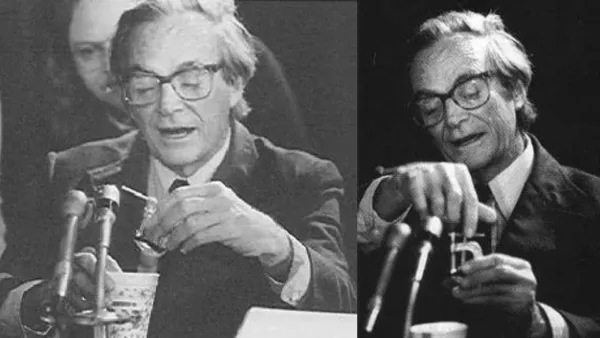
During a lull in testimony on February 11, 1986, Feynman took a section of O-ring material, compressed it with a small clamp and placed it in a glass of ice water. When he removed the clamp, the rubber did not spring back as a warm seal would. “I believe that has some significance for our problem,” he said, in the understated way that made the moment memorable.
What the demonstration showed, and what it did not
The demonstration showed one thing clearly: cold rubber recovers its shape slowly. It did not, by itself, prove the cause of the accident, and Feynman did not present it as a complete explanation. The Commission’s conclusions rested on a much larger body of evidence about the joint’s design, the erosion seen on earlier flights, and the decisions made before launch.
There is a revealing detail here. The effect Feynman reproduced with a glass of water had already been measured by the contractor. In bench tests reported in mid-1985, Morton Thiokol found that an O-ring held contact with the metal at 100°F, lost contact for 2.4 seconds at 75°F, and at 50°F had not re-established contact when the test was stopped after ten minutes. The physics was not hidden. It sat in a company letter eight months before Challenger flew.
Why a Physicist Was on the Rogers Commission
The commission and its members
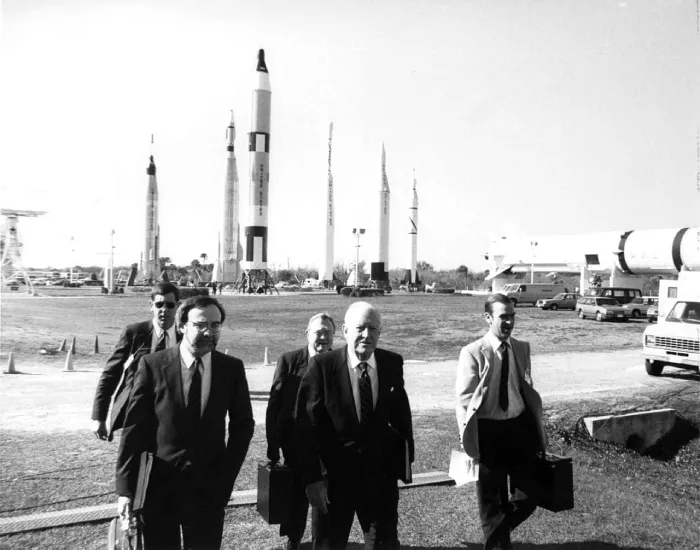
President Reagan created the Presidential Commission on the Space Shuttle Challenger Accident in early February 1986. It was chaired by William P. Rogers, a former Secretary of State, with astronaut Neil Armstrong as vice chairman. Its members included astronaut Sally Ride, Air Force General Donald Kutyna, and Feynman, who had won the 1965 Nobel Prize in Physics. The Commission reported in June 1986.
Feynman’s way of investigating
Feynman did not confine himself to the Commission’s schedule. The sources listed in his own appendix show what he did instead: he studied the certification records and Flight Readiness Reviews, interviewed engineers and managers at the Marshall Space Flight Center, spoke informally with engineers at Rocketdyne, visited the Johnson Space Center to examine the avionics, and read a Jet Propulsion Laboratory study of certification practices. Rogers is reported to have remarked that Feynman was becoming a real pain, a comment that captures the friction between a chairman managing an institutional inquiry and a commissioner who wanted to talk to the people doing the work.
What Caused the Challenger Disaster?
The solid rocket booster joint and the O-rings
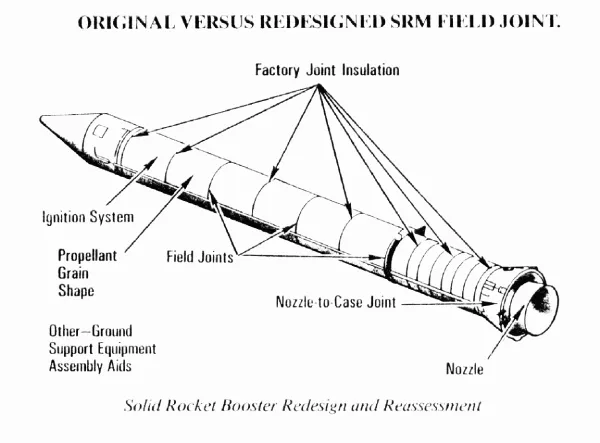
The Commission found that the accident began with a failure of the seal in a joint of the right solid rocket booster, allowing hot gas to burn through. The joint’s design was derived from the Air Force’s Titan III rocket, but with significant differences. The shuttle’s O-rings were meant to take the full force of combustion pressure, with only putty protecting them from the heat, and each segment was assembled horizontally for testing, an arrangement the Titan had never used for a motor this large.
The design assumed that pressure would press the joint tighter. A 1977 test showed the opposite: the joint opened slightly as the motor pressurised, a phenomenon the engineers called joint rotation. That reduced the pressure on the seal at the very moment it was needed.
A design warning in 1977
The warnings were early and specific. In September 1977, a Marshall engineering chief wrote that the design allowed O-ring clearance and should be corrected. A Marshall report the following month called leaving the design unchanged unacceptable. Two Marshall memoranda, in January 1978 and January 1979, pressed the point; the second called Thiokol’s position on the joint’s adequacy completely unacceptable. The Commission later learned that the engineer Leon Ray had actually written both memoranda, which his superior signed.
The design did not change. Instead, the classification did. In December 1982, after tests showed that the secondary O-ring could lose its seal as the joint rotated, NASA’s Marshall center reclassified the joint from Criticality 1R, meaning redundant, to Criticality 1, meaning a single point of failure whose loss could destroy the vehicle. A waiver approved at NASA headquarters in March 1983 allowed flights to continue. The Commission titled its chapter on this history “an accident rooted in history”, and the record supports the phrase.
Erosion becomes acceptable
The first in-flight erosion of a primary O-ring occurred after the second shuttle flight in November 1981. As more flights showed damage, the response was to widen what counted as acceptable rather than to redesign the joint. NASA and Thiokol had not expected the O-rings to be touched by hot gas at all, yet erosion was gradually reclassified as a tolerable condition supported by a calculated margin.
Then came flight 51-C in January 1985, launched at an O-ring temperature of 53°F, the coldest to that date. Hot gas penetrated a primary O-ring in a field joint for the first time, and the grease behind it was blackened by soot. For the first time, Thiokol’s analysis mentioned temperature as a factor. In July 1985, after serious damage on another flight, Marshall’s booster project manager imposed a formal launch constraint, which he then waived before each of the next six flights, including Challenger’s. The Commission found that neither the constraint nor the reasons for it reached the senior officials responsible for the launch.
The night-before warnings from Morton Thiokol engineers
On the afternoon of January 27, 1986, with launch rescheduled for the next morning, forecasts predicted temperatures as low as 18°F overnight and about 26°F at the planned launch time. Thiokol engineers in Utah, led by Roger Boisjoly and Arnold Thompson and joined by Robert Ebeling, grew alarmed and prepared charts for a teleconference with NASA’s Marshall and Kennedy centers.
The second teleconference began around 8:45 p.m. Thiokol’s vice president for engineering, Robert Lund, presented the engineers’ recommendation: do not launch below 53°F, the lowest O-ring temperature the shuttle had experienced. Marshall’s George Hardy said he was “appalled”. Larry Mulloy, the booster project manager, challenged the logic and, by his own recollection, asked in effect whether Thiokol expected NASA to wait until April. Thiokol’s Joe Kilminster asked for a five-minute private caucus. It lasted about thirty minutes.
Boisjoly’s testimony describes what happened in Utah: the engineers who opposed the launch kept arguing, and then Thiokol’s senior vice president told Lund to take off his engineering hat and put on his management hat. Lund later testified that the usual roles had reversed that night. Thiokol had always been expected to prove it was ready to fly; this time it found itself trying to prove to NASA that the motor would not work. It could not prove the negative, and the recommendation was reversed. Kilminster read out the new rationale at about 11 p.m., and NASA asked for it in writing.
The Commission concluded that Thiokol’s management reversed its position at Marshall’s urging and contrary to its engineers’ views, to accommodate a major customer. It also found that the objections never travelled upward: NASA’s launch director, its shuttle program manager and the associate administrator for space flight each testified that they had not known of Thiokol’s opposition. Challenger launched at 11:38 a.m. The Commission’s table lists the joint temperature at 31°F, 22 degrees below the previous coldest flight.
Did Feynman Really Discover the O-Ring Problem?
The Kutyna and Ride tip
The popular version of the story has Feynman identifying the O-ring problem by instinct and exposing it with a glass of ice water. The record is more complicated. General Kutyna later said that astronaut Sally Ride, a member of the Commission who was still a NASA employee, gave him NASA test data showing that the O-rings stiffened in cold weather. Kutyna said he wanted to get the information to Feynman without revealing its source, so he steered the conversation during a dinner at his home toward the effect of cold on a car engine’s seals, and Feynman followed the hint. Kutyna kept Ride’s role private until after her death in 2012, and a 2013 BBC film brought the account to wider attention.
What this changes about the legend
The tip does not diminish what Feynman did next. It does change who gets the credit for finding the temperature link. Thiokol’s engineers had raised cold-weather concerns in 1985 and again the night before launch, and their own bench tests showed the effect. What Feynman added was the public demonstration, a willingness to question managers directly, and a written analysis that moved the inquiry from a single faulty part to the system that had allowed the flaw to fly.
Inside Appendix F: Feynman’s Case Against NASA Management
Feynman insisted on including his own statement, and it appears as Appendix F in Volume 2 of the Commission’s report, titled “Personal Observations on the Reliability of the Shuttle.” It is the clearest primary source for his view, and it is far more systematic than the ice-water moment suggests.
One in 100 versus one in 100,000
Feynman opened with a puzzle. Estimates of the chance of losing a shuttle and its crew ranged from roughly 1 in 100 to 1 in 100,000. The higher figures came from working engineers, the lowest from management. He pointed out that 1 in 100,000 would imply flying a shuttle every day for 300 years and expecting to lose one.
Why the gap mattered
The gap was not a rounding difference. It meant that the people responsible for deciding to fly believed in a degree of safety that the people closest to the hardware did not. Feynman cited the range safety officer’s history of solid rocket flights, in which about 121 of nearly 2,900 had failed, and suggested that even mature, carefully built rockets might achieve better than 1 in 100 but probably not 1 in 1,000. He found a similar pattern with the shuttle’s main engines: engineers at the manufacturer estimated about 1 in 10,000, engineers at Marshall about 1 in 300, and NASA management 1 in 100,000.
How erosion was treated as a safety margin
Feynman’s sharpest analysis concerned the logic of acceptance. When a prior flight had eroded an O-ring to about a third of its thickness, officials noted that experiments showed it would take a full radius of erosion before the ring failed, and called the remainder a “safety factor” of three. Feynman argued that this misused the term. A bridge designed to carry three times its expected load is not safe if a crack appears under the normal load; the crack is evidence the design has failed. The O-rings were not designed to erode, so erosion was a clue that something was wrong, not a margin to spend.
He described the underlying habit as a kind of Russian roulette: a risk accepted once without disaster becomes evidence for accepting it again. He also criticised the mathematical model used to predict erosion, which was built from curve fitting rather than physical understanding and which, in his words, was believed more than its uncertainties justified.
Why Feynman fought to publish it
Appendix F is not a blanket condemnation. Feynman investigated the shuttle’s computer systems and found the software verification culture to be of the highest quality, with an independent group adopting an adversarial attitude toward the developers. He noted that this area showed none of the gradual fooling of oneself he saw in the booster and engine certification, and he warned management against cutting that testing. The contrast matters: his argument was about how certain organisations handled warnings, not about NASA as a whole.
What Feynman concluded
Feynman concluded that, under pressure to maintain a flight schedule, certification criteria were subtly altered so flights could be approved in time, leaving a real chance of failure on the order of one percent, which he acknowledged was difficult to estimate precisely. He offered two possible explanations for management’s far lower figure: an attempt to reassure the government of NASA’s perfection in order to protect funding, or a sincere belief that reflected an almost incredible lack of communication with its own engineers. He did not claim to know which. He ended with a principle that has outlived the shuttle: for a technology to succeed, reality must outrank public relations, because nature cannot be fooled.
Normalization of Deviance: How Risk Became Routine
Diane Vaughan’s research
The sociologist Diane Vaughan gave the pattern a name in her 1996 book The Challenger Launch Decision. She called it the normalization of deviance: the process by which a known anomaly, such as O-ring erosion or later foam strikes, was gradually redefined as normal because it had occurred before without catastrophe. Her work located the root of the accident in organisational systems and culture rather than only in the decisions of individuals.
Where Feynman and Vaughan agree, and where they differ
The two accounts overlap on the central mechanism. Feynman described standards that loosened because the previous flight had survived; Vaughan described deviance that became routine through the same logic. They differ in emphasis. Feynman asked why management believed what it believed and left open the possibility of motive. The Commission itself emphasised that Thiokol’s management reversed course to satisfy a customer. Vaughan’s analysis points away from individual misconduct towards the organisational conditions that made the decisions seem reasonable at the time. Both readings are supported by the record, and neither excludes the other.
Challenger and Columbia: The Pattern Repeats
Sally Ride’s role on both investigations
On February 1, 2003, the shuttle Columbia broke apart during re-entry, killing all seven crew members. Sally Ride, by then a veteran of the Challenger inquiry, served on the Columbia Accident Investigation Board, which examined the organisational causes alongside the physical ones.
Foam strikes and eroded O-rings compared
The physical cause was different: insulating foam shed from the external tank and struck the orbiter’s left wing during ascent. The organisational story was familiar. Foam strikes had occurred on shuttle flights for years despite a rule against debris, and because earlier flights had returned safely, they had come to be treated as routine. The Board concluded that NASA’s organisational culture was as much a cause of the accident as the foam, and Vaughan, whose normalization-of-deviance analysis informed the report, wrote much of its chapter on the subject. The Board’s report was explicit that it saw echoes of Challenger.
A simple tally supports Feynman’s engineers over management’s estimate. The shuttle flew 135 missions and was lost twice, a rate of about 1 in 67 by plain arithmetic. That is much closer to the engineers’ 1 in 100 than to management’s 1 in 100,000, and a later analysis hosted by NASA noted that probabilistic risk assessments of the shuttle produced figures in the neighbourhood of 1 in 100.
Disputed Claims and Open Questions
Was the temperature link visible in the data?
The night before launch, Thiokol’s engineers could not produce a quantified correlation between temperature and damage, and managers noted that a flight launched at 75°F had also shown blow-by. The Commission later examined the problem more completely. The managers had compared only flights that showed thermal distress, which hid the pattern. When all flights were considered, only three incidents of O-ring distress occurred in twenty flights at 66°F or above, while all four flights at 63°F or below showed distress. The Commission concluded that a careful analysis would have revealed the correlation, and that neither NASA nor Thiokol carried it out.
Was it a failure of engineering or of communication?
The Commission’s answer was both, but the individuals involved disagreed. Mulloy testified that he had told everyone of his concerns, while the Commission found that the seriousness of the problem was not conveyed to the senior managers who decided the launch. Hardy testified that the teleconference was a full discussion and that anyone who wished to speak was free to do so. Thiokol’s managers described their caucus as a rational weighing of engineering facts that ended in a judgment call. The engineers who opposed the launch described a meeting in which they felt pressed to prove the shuttle was unsafe rather than being asked to prove it was safe. The Commission gave more weight to the second account.
Feynman’s own estimates deserve the same caution. His one-percent figure was a rough judgment based on the engineers he consulted, and he said it was difficult to be more accurate. Its strength is as a challenge to management’s number, not as a precise measurement.
What the Challenger Investigation Still Teaches
The ice-water demonstration remains a masterclass in making a technical point visible. But the record shows that the lasting lesson lies elsewhere. A design flaw was identified early and classified rather than corrected. An anomaly that was supposed to be impossible became tolerable through repetition. Engineers who raised a concern were put in the position of having to prove danger. And the information that mattered most did not reach the people who made the final decision.
Feynman did not discover every part of this, and he was not the only person who understood it. What he did was refuse to accept the institution’s account of itself and write down, in plain language, why the numbers it relied on could not be trusted. Seventeen years later, the Columbia investigators found the same pattern at work. Whether the lesson has been learned is a question each organisation that handles dangerous technology has to answer for itself.
Stay Updated: Follow our WhatsApp Channel and Telegram Channel.
Sources and References
Primary sources
- Report of the Presidential Commission on the Space Shuttle Challenger Accident, Volume 2, Appendix F: Feynman, “Personal Observations on the Reliability of the Shuttle.” NASA History Office.
- Report of the Presidential Commission, Volume 1, Chapter V: “The Contributing Cause of the Accident.”
- Report of the Presidential Commission, Volume 1, Chapter VI: “An Accident Rooted in History.”
- Hearings of the Presidential Commission, February 11, 1986 (transcript).
- Hearings of the Presidential Commission, Volume 4 index and testimony.
Analysis and secondary sources
- Diane Vaughan, The Challenger Launch Decision: Risky Technology, Culture, and Deviance at NASA (University of Chicago Press, 1996).
- Columbia Accident Investigation Board, Report, Volume 1 (2003), including Chapter 8, “History as Cause: Columbia and Challenger.”
- NASA SP-2006-4702, “Critical Issues in the History of Spaceflight,” Section V, “NASA Cultures.” https://www.theblackvault.com/documents/space/nasa/sp-2006-4702-Section5.pdf
- Spaceflight Now, “20 years after Columbia disaster, lessons learned still in sharp focus at NASA” (February 1, 2023). https://spaceflightnow.com/2023/02/01/20-years-after-columbia-disaster-lessons-learned-still-in-sharp-focus-at-nasa/
- Nautilus, “How Richard Feynman Found the Root of the Challenger Disaster.” https://nautil.us/how-richard-feynman-found-the-root-of-the-challenger-disaster-1264270/
- Physics World, “BBC celebrates Richard Feynman.” https://physicsworld.com/a/bbc-celebrates-richard-feynman/
- Richard Feynman, What Do You Care What Other People Think? (1988).
- NASA Technical Reports Server, document 20210021685, paper on shuttle risk and organisational failure. https://ntrs.nasa.gov/citations/20210021685