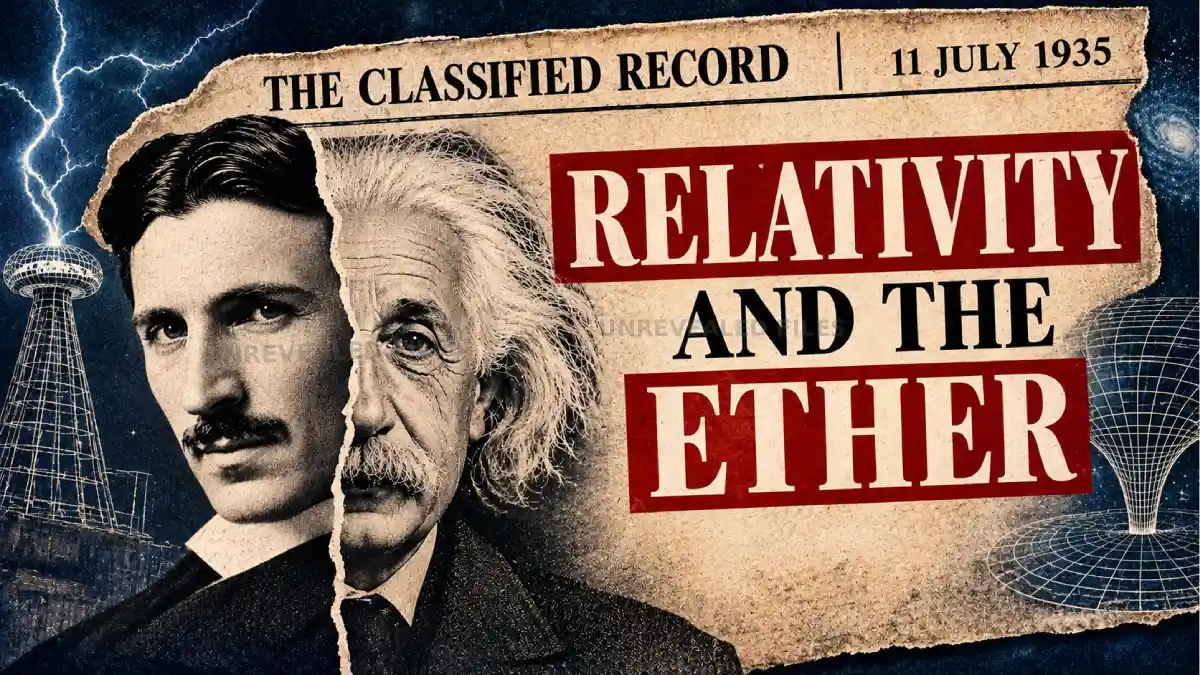
On 10 July 1856 Nikola Tesla was born. Seventy-nine years later, he spent his birthday doing what he did every year: giving reporters an interview. This one made news around the world. Press reports said he claimed to have completed studies that “knocked the props” from under Einstein’s relativity theory, and that he had measured the velocity of cosmic rays from the star Antares.
The story has been repeated ever since, usually with a quote that is slightly wrong and a conclusion that goes further than the evidence. Tesla did reject relativity. The harder questions are what exactly he objected to, what his alternative was, and whether any of his claims survived the experiments that followed.
What Tesla actually said in 1935
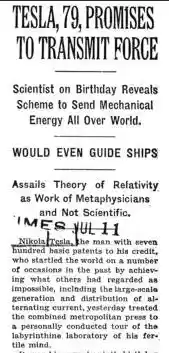
The key record is a New York Times report of 11 July 1935, headlined “Tesla, 79, Promises to Transmit Force,” and widely reprinted. Its subheading described him as assailing the theory of relativity as the work of metaphysicians rather than scientists.
The most famous line is usually quoted as “Einstein’s relativity work is a magnificent mathematical garb.” That wording is a garbled paraphrase. In the reported interview, Tesla said the theory wraps errors and fallacies in a “magnificent mathematical garb” that fascinates and dazzles people and blinds them to the errors underneath. The second half of the famous phrase, the image of a beggar in purple, was reported as relativity being “a beggar wrapped in purple whom ignorant people take for a king.” A journalist at his birthday luncheon recorded the same remarks a month later.
Two points are worth noticing. First, Tesla’s complaint was partly about method. He thought relativity’s mathematics had run ahead of physical demonstration. Second, he did not present himself as an outsider sniping at physics. Four years earlier, at 75, he told reporters he was working on an explanation, based on pure mathematics, of certain things Einstein had also tried to explain. He saw himself as a rival theorist.
Why an electrical engineer defended the ether
Tesla’s position makes sense once you place him in his own era. He built his career in the physics of the late nineteenth century, when light was understood as a wave in an invisible medium, the luminiferous ether. For an engineer working with electric and magnetic fields, that picture was intuitive and productive. One commentator summarises it as the ether theory being suitable for every problem that interested Tesla, and being more intuitive than what replaced it.
His objection to curved space was blunt. Remarks attributed to him in the early 1930s hold that space cannot be curved because it has no properties. That line is widely quoted, but we could not trace it to an original printing, so treat it as attributed rather than confirmed. It does capture his logic. If space is empty, nothing can bend it. If something bends, it must be a medium.
His own ether was physical and mechanical. Writing in 1908, he described the ether as a fluid which, when set in motion, becomes ordinary matter, and which reverts to its primary state when the motion stops. That is a very different object from anything in Einstein’s physics.
The cosmic ray claim
The 1935 claim that did the most to isolate Tesla was his statement that he had measured cosmic rays from Antares. The Tesla-versus-Einstein literature ties this to his belief, dating back to around 1900, that he had intercepted cosmic rays from the Sun. His interpretation required signals travelling faster than light, which special relativity forbids.
The modern understanding of cosmic rays is that they are charged particles, mostly atomic nuclei, moving close to, but below, light speed. We found no record that anyone independently reproduced Tesla’s measurement. That absence matters, because a faster-than-light result would be among the most important findings in physics. It was never confirmed.
Did Einstein bring the ether back?
Tesla’s defenders often point to Einstein’s 1920 lecture at Leiden University, “Ether and the Theory of Relativity.” It is real, and the quotation is striking. Einstein said the change special relativity brought to the ether was to remove its last mechanical property, its immobility. To many readers this sounds like a concession to Tesla.
Historians of physics read it differently. Einstein himself said general relativity was closer to the ether hypothesis than special relativity, in a 1916 letter to Lorentz, and one analysis calls that a gesture of respect, since Lorentz had never abandoned the concept. Another study argues that the ether Einstein described at Leiden was metaphorical, referring to the geometric properties of spacetime, with no mechanical or particulate qualities. Others stress that it was not Lorentz’s ether.
That settles the central point. The word survived; the concept Tesla relied on did not. A medium with mechanical properties that carries light and can be set whirling into matter is not what general relativity describes. The two men may have shared a word, but they were describing different things.
What a century of experiments has shown
Tesla’s claim that no proposition of relativity had been proved was, in 1935, a defensible reading of a young and still thinly tested theory. It cannot be defended now.
The ether tests began before Tesla’s career peaked. In 1887 Michelson and Morley tried to detect the ether with two light paths and found no difference in return times. Since then, tests of special relativity have accumulated. The Ives–Stilwell experiments of 1938 and 1941 verified time dilation by measuring a shift in light from moving atoms that matched Einstein’s prediction. The 1971 Hafele–Keating experiment flew atomic clocks around the world and found results consistent with relativistic predictions within experimental error.
General relativity has been tested even more severely. Gravity Probe A in 1976 confirmed Einstein’s redshift prediction to 1.4 parts in 10,000. Gravity Probe B, launched in 2004, used gyroscopes in Earth orbit to test the geodetic and frame-dragging effects. The 2015 LIGO detection of gravitational waves from merging black holes added another confirmation.
The most practical evidence is in your pocket. GPS satellite clocks run about 45.6 microseconds per day faster because of gravity and about 5.6 microseconds slower because of speed, a net of roughly 40 microseconds a day that must be corrected. Without the correction, the system would be useless. Tesla’s rejection of relativity would, if followed literally, break satellite navigation.
Where Tesla’s scepticism still has a point
It would be too easy to dismiss everything. Relativity and quantum mechanics are both extremely well tested, yet they have not been unified. Physicists are still looking for ways to integrate Einstein’s theory of gravity with quantum theory, a hundred years after the quantum revolution. Tesla’s instinct that the foundations were incomplete is not absurd. But it is a long way from there to saying that his ether is the answer, and that is exactly the leap many online posts make.
The fact-check literature offers a useful warning. Viral posts claim that Tesla did wonders with ether, that powerful interests hid the discoveries, and that ether was erased from history books and the periodic table. A review concluded that ether was never discovered in the first place. The version of Tesla that circulates on social media is often a political symbol rather than a historical figure.
Why this matters for the Tesla legend
There is an irony that rarely surfaces in the “secret time machine” stories. Serious scientific discussion of time travel begins with relativity, which treats time as part of a flexible spacetime. The man at the centre of those stories publicly rejected the physics in which time travel is even a question. If you want the full story of how that legend grew, see our investigation into the Tesla and Barron Trump time travel claims.
Conclusion
Tesla did reject relativity, publicly and repeatedly, and the 1935 interview is the clearest record of it. His reasons were rooted in the physics of his youth: a mechanical ether, a distrust of mathematics that outpaced experiment, and a measurement of cosmic rays that no one else has reproduced.
Einstein’s Leiden lecture does not rescue him. It shows that Einstein kept the word “ether” for a very different concept. And the experiments that Tesla could not have known about, from atomic clocks to gravitational waves, have gone against him on the specific claim he made.
The better question is why this episode matters. A brilliant inventor can be extraordinary in one field and mistaken in another. Reading what Tesla actually said, rather than the slogans attributed to him, is the only way to tell the two apart.
Also Read:
- Did Nikola Tesla Invent Time Travel? The Barron Trump Mystery
- Nikola Tesla’s Missing Papers
- Nikola Tesla and the Mystery of His Earthquake Machine
Stay Updated: Follow our WhatsApp Channel and Telegram Channel.
Sources and references
- New York Times, “Tesla, 79, Promises to Transmit Force,” 11 July 1935, p. 23 (reprint and transcriptions): https://teslauniverse.com/nikola-tesla/articles/tesla-79-promises-transmit-force
- INS wire report, “Inventor Scorns Theory of Relativity,” 11 July 1935: https://teslauniverse.com/nikola-tesla/articles/inventor-scorns-theory-relativity
- “Tesla, 79 Years Old, Is Wonder Man of Science,” 10 August 1935: https://teslauniverse.com/nikola-tesla/articles/tesla-79-years-old-wonder-man-science
- “Human Side of News,” 12 August 1935: https://teslauniverse.com/nikola-tesla/articles/human-side-news-can-science-end-war-making-it-universally-destructive
- Hokitika Guardian, 12 July 1935, p. 5: https://paperspast.natlib.govt.nz/newspapers/HOG19350712.2.19
- Taranaki Daily News, 12 July 1935, p. 5: https://paperspast.natlib.govt.nz/newspapers/TDN19350712.2.80
- Time, “Science: Tesla at 75” (1931): https://time.com/archive/6747615/science-tesla-at-75
- Einstein, “Ether and the Theory of Relativity” (Leiden, 1920), translation: https://mathshistory.st-andrews.ac.uk/Extras/Einstein_ether
- Einstein Papers Project, Doc. 38: https://einsteinpapers.press.princeton.edu/vol7-trans/176
- G. Weinstein, “Convergences and Divergences: Einstein, Poincaré, and Special Relativity”: https://arxiv.org/pdf/2509.09361
- “Einstein, Free Creations, and His Worldly Cloister”: https://arxiv.org/pdf/2505.09530
- Comment on Weinstein’s article: https://arxiv.org/pdf/2510.03793
- Gravity Probe B final results: https://arxiv.org/pdf/1105.3456
- NASA/Stanford, GP-B mission overview: https://einstein.stanford.edu/MISSION/mission1.html
- GPS and time dilation: https://arxiv.org/pdf/1710.07381
- “Nature of time and causality in Physics” (Hafele–Keating, Pound–Rebka): https://arxiv.org/pdf/0710.0428
- Science Feedback, “No proof for the existence of a mystery element named ether”: https://science.feedback.org/review/no-proof-for-the-existence-of-a-mystery-element-named-ether/
- IFLScience, “Nikola Tesla Was Brilliant, But He Got A Surprising Number Of Things Wrong” (2026): https://www.iflscience.com/nikola-tesla-was-brilliant-but-he-got-a-surprising-number-of-things-wrong-83606
FACT CHECK: We strive for accuracy and fairness. But if you see something that doesn’t look right, please Contact us.
DISCLOSURE: This Article may contain affiliate links and Sponsored ads, to know more please read our Privacy Policy.