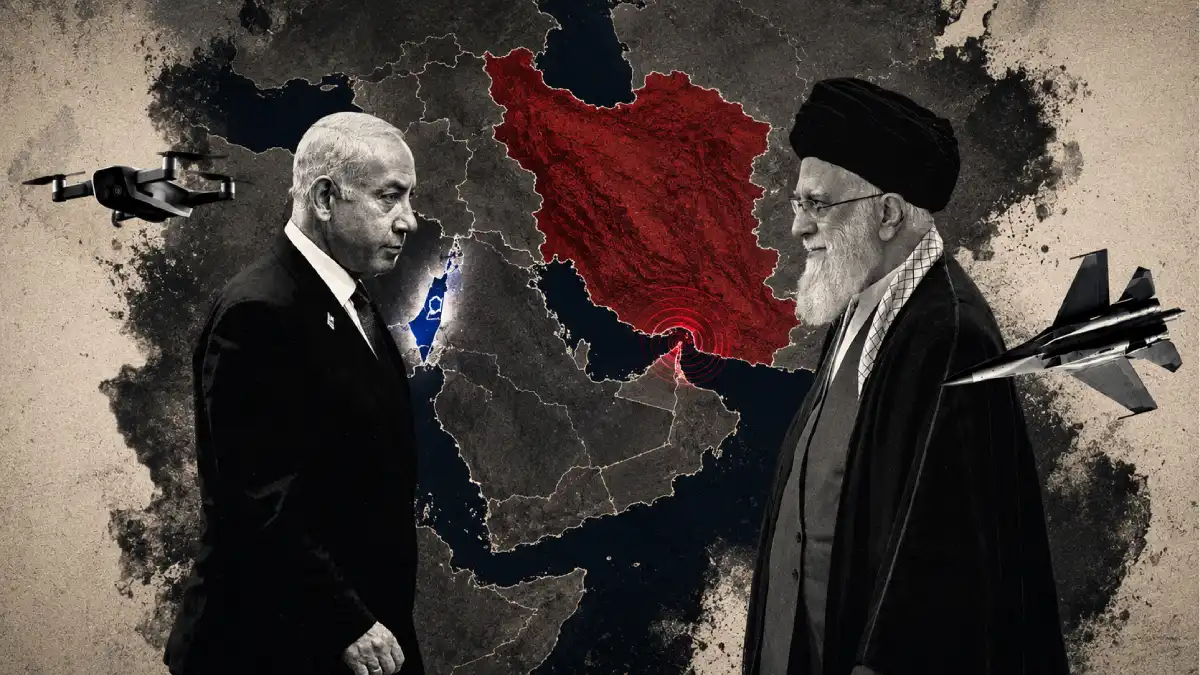
For decades, the conflict between Israel and Iran has unfolded largely outside traditional battlefields. There were no formal declarations of war, no massive troop invasions, and no single moment the world could point to as the beginning. Yet beneath the surface of Middle Eastern geopolitics, a relentless shadow war has shaped assassinations, cyberattacks, proxy militias, drone strikes, and covert operations across continents.
It is a conflict fought in silence through intelligence agencies, hacked infrastructure, anonymous explosions, and deniable attacks. From sabotaged nuclear facilities to mysterious killings in Tehran and missile launches across regional borders, the Israel-Iran confrontation has evolved into one of the most sophisticated covert conflicts of the modern era.
Today, that hidden war is no longer entirely hidden.
From Allies to Enemies
Before 1979, Iran and Israel were not bitter enemies. Under Shah Mohammad Reza Pahlavi, Iran maintained quiet but strategic ties with Israel. The two countries shared intelligence cooperation and viewed rising Arab nationalism as a mutual concern.
Everything changed after the Iranian Revolution.
The new Islamic Republic transformed Iran’s foreign policy around resistance to Israel and opposition to Western influence in the Middle East. Israel, in turn, viewed the revolutionary regime as an existential threat, especially as Tehran expanded its regional influence and pursued advanced missile and nuclear programs.
Over time, the conflict evolved into a long-term strategic confrontation involving espionage, sabotage, economic warfare, and regional proxy networks. At the center of this shadow conflict are two powerful institutions:
- Mossad
- Islamic Revolutionary Guard Corps
Both operate far beyond their borders. Both specialize in covert operations. And both have spent decades preparing for a conflict neither side officially wants to declare.
The Gulf States and the Israel-Iran Shadow War
For Gulf states, the shadow war created a dangerous balancing act. Countries heavily dependent on oil exports and maritime trade feared that any confrontation between Israel and Iran could destabilize energy markets and threaten shipping routes across the Persian Gulf.
As attacks on oil facilities, tankers, and regional infrastructure increased over the years, Gulf governments expanded investments in:
- air defense systems
- maritime security
- cyber defense
- regional military partnerships
Many Gulf leaders also attempted to reduce tensions diplomatically, aware that a wider regional war could severely damage their economies and internal stability. The shadow conflict demonstrated how even covert warfare between two rival powers could place the entire region under constant strategic pressure.
The Assassination Campaign
One of the most controversial dimensions of the shadow war has been the targeted killings of Iranian nuclear scientists and military officials.
Over the years, several Iranian figures linked to nuclear development died in car bombings, shootings, or unexplained incidents. Tehran repeatedly accused Israel of orchestrating these operations through covert networks operating inside Iran.
The most dramatic case came in 2020 with the assassination of Mohsen Fakhrizadeh, widely considered a central architect of Iran’s nuclear ambitions. According to multiple international reports, the attack involved highly advanced surveillance systems and remote-controlled weaponry.
The operation shocked intelligence experts worldwide because it demonstrated how modern covert warfare had evolved beyond traditional espionage. Artificial intelligence, satellite communications, facial recognition, and automated targeting systems appeared to blur the line between cyberwarfare and physical assassination.
For Israel, such operations were reportedly designed to slow Iran’s nuclear progress without triggering full-scale war. For Iran, they represented humiliation proof that foreign intelligence networks had penetrated deep into the country’s security apparatus. The result was escalation through retaliation rather than open invasion.
The Cyber Battlefield
Perhaps nowhere has the Israel-Iran shadow war become more revolutionary than cyberspace. In 2010, the world learned about Stuxnet, a sophisticated computer worm that infiltrated Iran’s Natanz nuclear facility and physically damaged uranium centrifuges.
Unlike ordinary malware, Stuxnet was designed to destroy real-world infrastructure while appearing invisible to operators monitoring the systems. Cybersecurity researchers later described it as one of the first true digital weapons capable of causing physical destruction.
The implications were enormous. For the first time in history, software had effectively become an instrument of sabotage comparable to conventional military strikes.
The attack transformed global military thinking. Governments around the world realized that future wars would not only be fought with missiles and tanks, but with malicious code capable of crippling energy grids, transportation systems, communications networks, and financial institutions.
Since then, both Israel and Iran have been accused of launching cyber operations targeting:
- ports
- water systems
- transportation infrastructure
- surveillance systems
- oil facilities
- communications networks
The battlefield had expanded into invisible territory where attribution became difficult, and retaliation could occur without warning. In many ways, the Israel-Iran conflict became a preview of twenty-first-century warfare itself.
The Proxy War Across the Middle East
Although Israel and Iran rarely fight directly, their influence stretches across nearly every major conflict zone in the Middle East.
Iran has spent decades building a network of allied militias and armed groups across the region. These organizations function both as strategic deterrents and instruments of regional influence.
Among the most significant are:
- Hezbollah
- Hamas
Through these alliances, Iran extends pressure against Israel without engaging in conventional interstate warfare. Meanwhile, Israel has carried out hundreds of reported airstrikes and intelligence operations targeting Iranian weapons transfers, military infrastructure, and proxy positions in countries such as:
- Syria
- Lebanon
- Iraq
Syria became one of the most critical arenas of this hidden conflict. As Iran expanded its military footprint there during the Syrian Civil War, Israel intensified strikes aimed at preventing advanced weapons systems from reaching Hezbollah.
This transformed the shadow war into a sprawling regional contest fought through deniable operations, local militias, drone campaigns, and strategic assassinations.
The borders of the war became increasingly impossible to define. Over time, the conflict transformed Syria, Lebanon, and Gaza into interconnected fronts within a much larger regional confrontation. Weapons transfers, intelligence operations, militia coordination, and missile networks increasingly linked these territories together under the broader Israel-Iran rivalry.
An airstrike in Syria could influence tensions in Lebanon. Escalation in Gaza could trigger regional responses from Iran-aligned groups elsewhere. What once appeared as separate local conflicts gradually became part of a single strategic theater stretching across the Middle East. This interconnected battlefield structure made containment far more difficult and increased the risk that local clashes could rapidly expand into broader regional crises.
The Realignment of Middle Eastern Alliances
The Israel-Iran shadow war also accelerated major geopolitical realignments across the region.
Several Arab governments that historically kept Israel at a distance began quietly reassessing their strategic priorities as Iran’s regional influence expanded. Shared concerns over Iranian missile programs, proxy militias, and regional instability contributed to unprecedented diplomatic openings between Israel and several Arab states.
Security cooperation, once politically unthinkable, has increasingly evolved behind the scenes through intelligence coordination, defense discussions, and regional security planning. At the same time, Iran strengthened ties with allied non-state actors and regional partners to preserve strategic depth across the Middle East.
The result was a region divided less by traditional Arab-Israeli politics and more by competing security blocs shaped by the Israel-Iran rivalry.
How the Conflict Changed Regional Policy
For years, the shadow war forced governments across the Middle East to rethink their military and foreign policies. Countries that once focused primarily on conventional warfare began investing heavily in:
- missile defense systems
- cybersecurity
- drone surveillance
- intelligence coordination
- electronic warfare
Israel accelerated the development of multilayered air-defense systems designed to counter rockets, drones, and long-range missile threats from Iran and its regional allies. Meanwhile, Iran expanded its strategy of asymmetric warfare, relying less on traditional military confrontation and more on proxy groups, cyber capabilities, and missile deterrence.
The conflict also pushed regional governments to strengthen intelligence-sharing networks and security cooperation, particularly as fears grew over cyber sabotage and attacks on critical infrastructure.
Across the Middle East, national security doctrines are increasingly adapted to a new reality: wars could now begin without armies crossing borders.
Drones, Missiles, and the New Escalation
In recent years, the shadow war entered a more dangerous phase.
What had once remained largely covert began shifting into increasingly confrontational. Missile exchanges, drone attacks, maritime incidents, and regional military strikes pushed tensions closer to open warfare. Both Israel and Iran invested heavily in drone technology, electronic warfare capabilities, and precision missile systems.
The rise of inexpensive but highly effective drones changed the strategic equation dramatically. Non-state groups and proxy militias could suddenly threaten advanced military infrastructure with asymmetric attacks that were difficult to predict and even harder to stop completely.
At the same time, cyberwarfare became more integrated with physical operations. Intelligence gathering, satellite monitoring, digital sabotage, and psychological operations increasingly operated together as part of a unified conflict strategy.
The modern battlefield no longer exists in one location. It existed everywhere at once.
Why the Israel-Iran shadow war matters for the World
The Israel-Iran shadow war matters far beyond the Middle East. Any escalation between the two powers carries global consequences:
- disruptions to oil markets,
- instability in shipping routes
- Cyber threats against international infrastructure
- risks to global energy supplies
- broader military escalation involving world powers
The conflict also represents a larger transformation in how wars are fought. Traditional warfare once depended on visible armies and declared battles. Modern shadow warfare depends on:
- deniability
- cyber sabotage
- intelligence penetration
- autonomous systems
- drones
- information warfare
- proxy networks
This model is increasingly being studied and replicated by governments worldwide. The Israel-Iran confrontation has effectively become a laboratory for future conflict.
The Gulf States and the Fear of Escalation
One of the greatest international concerns surrounding the Israel-Iran shadow war is the vulnerability of the Strait of Hormuz, a narrow maritime corridor through which a significant portion of the world’s oil supply passes every day.
Iran has repeatedly signaled that escalating regional conflict could threaten shipping security in the Gulf, raising fears of disruptions to global energy markets and international trade routes.
Even limited confrontations near the waterway have historically triggered spikes in oil prices, increased naval deployments, and heightened tensions between regional and global powers.
As a result, the shadow conflict between Israel and Iran now carries consequences far beyond the Middle East, linking covert regional warfare to the stability of the global economy.
A New Middle Eastern Power Structure
The long-running shadow war between Israel and Iran has done more than fuel regional instability; it has fundamentally altered the balance of power across the Middle East. Traditional state-on-state military dominance became less important than influence networks, intelligence capabilities, cyber operations, and proxy alliances.
Smaller armed groups backed by regional powers gained the ability to shape geopolitical events far beyond their borders. Cyber units and drone operators emerged as strategic assets comparable to conventional military forces. Meanwhile, regional governments increasingly measured security not only through territorial defense, but through technological superiority, intelligence penetration, and strategic partnerships.
The result is a Middle East defined less by clear frontlines and more by overlapping zones of influence, covert operations, and continuous low-intensity conflict. In many ways, the Israel-Iran shadow war became the blueprint for a new era of regional competition. Despite periodic ceasefires, diplomatic efforts, and international pressure, the shadow war shows little sign of disappearing.
Because shadow wars rarely end through treaties. They evolve.
The struggle between Israel and Iran now stretches across cyberspace, intelligence networks, maritime corridors, satellite systems, and regional alliances. It is fought through algorithms as much as ammunition, through surveillance systems as much as soldiers. And unlike conventional wars, there may never be a clear victory.
Only new phases of escalation are hidden beneath the surface of world events. For the outside world, explosions and headlines appear isolated: a hacked facility here, an airstrike there, a mysterious assassination somewhere else. But behind them lies a decades-long invisible conflict reshaping the Middle East and redefining the future of warfare itself.
The struggle between Israel and Iran now stretches across cyberspace, intelligence networks, maritime corridors, satellite systems, and regional alliances. It is fought through algorithms as much as ammunition, through surveillance systems as much as soldiers. And unlike conventional wars, there may never be a clear victory. Only new phases of escalation are hidden beneath the surface of world events.
Also Read: Invisible War in Orbit: Are GPS Disruptions a Sign of Secret Global Conflict?
Sources & Further Reading
- “Iran and Israel’s Open Warfare After Decades of Shadow War.” Investing.com, 2024.
- “Iran Says ‘Smart Satellite-Controlled Machine Gun’ Killed Top Nuclear Scientist.” Investing.com, 2021.
- “Iran Blames Israel for Stuxnet Worm.” Ynetnews, 2011.
- “Exclusive: Iran Made Preparations to Mine the Strait of Hormuz, U.S. Sources Say.” Investing.com, 2025.
- “Iran Could Disrupt the Strait of Hormuz With Drones for Months.” Investing.com, 2025.
- “U.S. Secretary of State Rubio Sees Progress in Iran Talks, More Work to Be Done.” Reuters, 2026.
- “No Deal, No Exit: How U.S.-Iran Standoff Risks Fresh Conflict.” Reuters, 2026.
- “U.S. and Iran Report Progress on Talks Ending War.” Reuters, 2026.
- “Trump Says U.S. May Strike Iran Again, but Tehran Wants Deal.” Reuters, 2026.
- “UAE Restores Power to Barakah Nuclear Plant After Drone Strike.” The Guardian, 2026.
FACT CHECK: We strive for accuracy and fairness. But if you see something that doesn’t look right, please Contact us.
DISCLOSURE: This Article may contain affiliate links and Sponsored ads, to know more please read our Privacy Policy.
Stay Updated: Follow our WhatsApp Channel and Telegram Channel.