
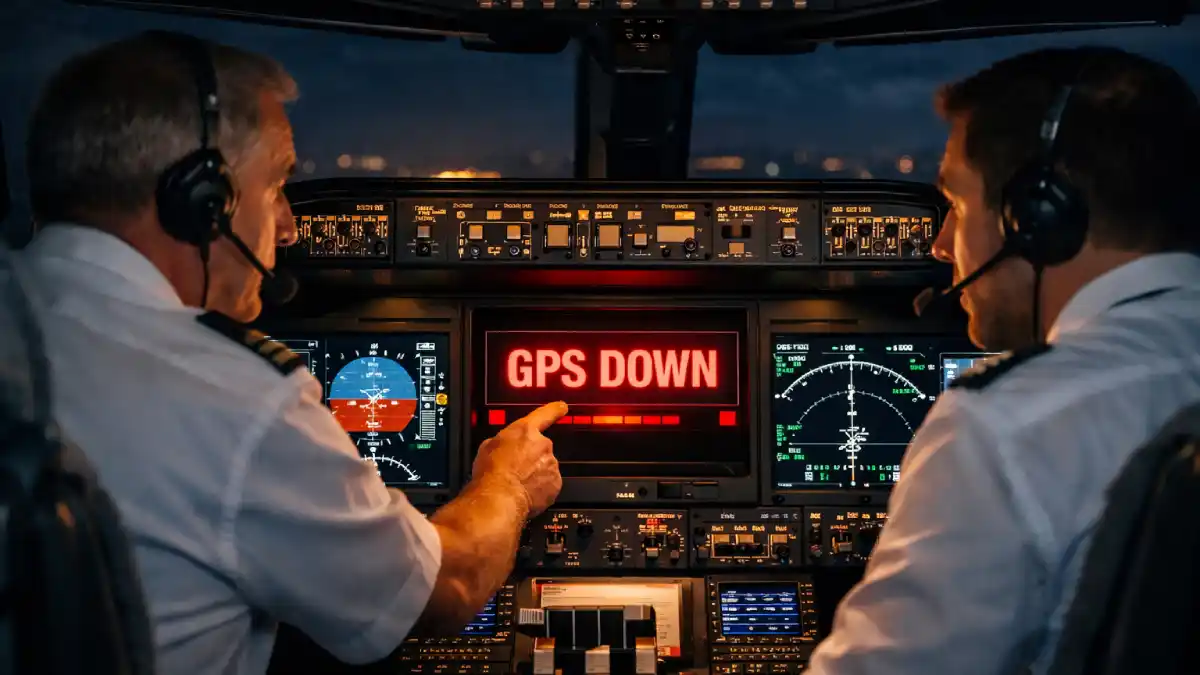
In early 2026, commercial pilots flying over parts of Eastern Europe began reporting something deeply unsettling: their navigation systems were no longer telling the truth. GPS signals failed without warning, position data shifted mid-flight, and backup systems became essential rather than optional. At sea, cargo vessels experienced similar anomalies, with routes drifting and coordinates placing ships miles away from their actual locations. In cities, drivers relying on navigation apps were rerouted unpredictably.
These were not isolated glitches. They were signals of deliberate or otherwise interference. And while governments have acknowledged “disruptions,” they have largely avoided answering a more pressing question: who is controlling the signals that guide the modern world and why?
The Infrastructure We Don’t See
Modern civilization depends heavily on satellite infrastructure, far more than most people realize. Global Navigation Satellite Systems such as GPS, Galileo, GLONASS, and BeiDou power aviation navigation, maritime shipping, financial transaction timing, emergency response coordination, telecommunications networks, and ride-sharing platforms. These systems are designed to be precise and reliable, yet they share a critical vulnerability: by the time their signals reach Earth, they are extremely weak, making them surprisingly easy to disrupt.
What Is GPS Jamming?
GPS jamming occurs when radio signals overwhelm satellite frequencies, preventing receivers from locking onto accurate positioning data. Unlike cyberattacks, jamming doesn’t require breaching systems. It simply drowns them out.
The consequences can include:
- Total loss of navigation
- Intermittent positioning errors
- Frozen or delayed location updates
Jamming technology ranges from:
- Advanced military-grade systems
- Portable, low-cost devices
- Deployments from ground stations, vehicles, ships, or aircraft
While its use in conflict zones is often deliberate, its growing presence outside those areas raises more complex concerns.
The Rise of GPS Spoofing
More advanced and significantly more deceptive is GPS spoofing. Rather than blocking signals, spoofing manipulates them by feeding receivers false positioning data, causing systems to believe they are somewhere they are not. Unlike jamming, which is usually obvious, spoofing can remain undetected.
- Ships have reported appearing inland.
- Aircraft have received conflicting positional data.
- Critical systems have processed false coordinates without immediate detection.
If jamming creates confusion, spoofing creates deception.
Despite the growing frequency of these incidents, official explanations remain deliberately vague. Authorities often attribute disruptions to “technical anomalies” or “regional interference,” yet patterns suggest something more coordinated. The geographic clustering of incidents, particularly near conflict zones and strategic corridors, raises the possibility that these are not random failures, but controlled demonstrations of capability.
What remains unclear is whether these disruptions are defensive measures, offensive signaling, or tests of escalation boundaries in a domain where accountability is almost impossible to prove.
A Pattern Across Regions
Reports of GPS disruption are no longer isolated; they are global and increasing. Across Eastern Europe, aviation authorities have repeatedly warned of signal interference linked to regional tensions, with even high-profile flights such as one carrying Ursula von der Leyen reportedly experiencing GPS jamming mid-air.
In India, aviation regulators, including the Directorate General of Civil Aviation, have issued advisories after multiple aircraft reported GPS spoofing during landing approaches at major airports such as Delhi and Mumbai, forcing pilots to rely on alternative navigation systems.
One of the most striking maritime cases has emerged from the Strait of Hormuz, a corridor critical to global oil supply. Ships navigating the region have reported spoofing incidents that caused them to appear miles inland or far from their actual routes. According to Scientific American, these disruptions form part of a broader and recurring pattern affecting maritime traffic in high-tension zones.
Taken together, these incidents suggest something more coordinated than isolated anomalies. Whether defensive measures, strategic signaling, or controlled demonstrations of capability, the pattern is becoming harder to ignore.
Why Satellites Are Strategic Targets
Satellites are not just communication tools.
They are critical infrastructure.
Disrupting them even indirectly can:
- Compromise military coordination
- Disrupt global supply chains
- Delay emergency response systems
- Create widespread civilian confusion
- Undermine trust in digital systems
Unlike physical infrastructure, satellites cannot be easily defended.
And signal interference operates in a gray area below the threshold of open warfare. This makes it an ideal tool for modern gray-zone conflict.
Military Use vs Civilian Impact
Governments often deploy jamming and spoofing as tactical measures:
- Shielding sensitive military sites
- Disrupting hostile drones
- Concealing troop movements
- Preventing precision targeting
But these actions don’t stay contained. Civilian systems rely on the same signals.
The result:
- Commercial flights lose navigation reliability
- Ships deviate from intended routes
- Emergency services face delays
- Financial systems experience timing disruptions
The line between military intent and civilian consequence is rapidly disappearing.
Governments justify jamming and spoofing as necessary tools for national security, particularly in counter-drone operations and battlefield concealment. However, what is rarely addressed publicly is the scale of collateral disruption. Civilian systems, aviation, shipping, and financial networks are not separate from military infrastructure; they are intertwined with it.
This raises an uncomfortable possibility: Are civilian disruptions an unintended side effect or an accepted cost?
The Classified Layer
Much of what happens in satellite interference remains hidden.
This includes:
- Real-time detection capabilities
- Attribution intelligence
- Countermeasure technologies
- Offensive electronic warfare programs
- System vulnerability assessments
Governments understand the risks. They also understand each other’s capabilities. What remains unclear is how much of this reality is shared with the public.
Much of what is known about satellite interference remains classified, not just the capabilities, but also the frequency and scale of incidents. Governments possess advanced detection systems and intelligence tools capable of identifying sources of interference, yet public attribution is rare.
This silence may not be accidental.
Acknowledging the true extent of interference could expose vulnerabilities, reveal strategic intentions, or escalate geopolitical tensions. In some cases, not confirming responsibility may be more strategic than denying it.
The Challenge of Attribution
One of the most dangerous aspects of satellite interference is the ability to maintain plausible deniability.
Jamming sources can be:
- Mobile
- Temporary
- Difficult to localize
- Hidden within background radio noise
Spoofing is even harder to trace. This makes accountability elusive. States can disrupt systems without openly claiming responsibility, complicating diplomacy, escalation control, and international response.
The inability to definitively attribute interference is not just a technical limitation; it is a strategic advantage. Jamming and spoofing allow actors to operate in a space where actions have real-world consequences, but limited accountability.
This creates a new kind of power dynamic: States can disrupt systems without openly claiming responsibility, complicating diplomacy, escalation control, and international response.
The Limits of Current Regulation
Existing space law was never designed for this kind of conflict.
It addresses:
- Orbital debris
- Satellite registration
- Peaceful use of space
But it largely ignores:
- Signal interference
- Electronic warfare targeting satellites
- Civilian spillover effects
- Accountability for spoofing operations
The regulatory framework is outdated, and the gap is widening.
A Growing Dependency
At the same time, dependence on satellite systems is accelerating. Emerging technologies rely even more heavily on precision positioning:
- Autonomous vehicles
- Smart infrastructure
- Precision agriculture
- Drone logistics
- Financial network synchronization
This creates a critical paradox: The more advanced systems become, the more vulnerable they are to invisible disruption.
The Silent Escalation
Satellite interference leaves no visible destruction.
No explosions.
No immediate casualties.
No dramatic imagery.
Yet its impact is systemic:
- Delayed global shipments
- Misrouted aircraft
- Financial timing errors
- Reduced situational awareness
These are not isolated inconveniences. They are signs of structural fragility.
The Question That Remains
By 2026, satellite interference is no longer rare; it is persistent, global, and increasingly normalized. Flights continue to operate. Ships continue to sail. Systems continue to function, just not always accurately.
Governments acknowledge the issue, but only in fragments. Incidents are reported, but rarely explained. Capabilities are hinted at, but never fully revealed.
Which leaves a more unsettling question:
Is this disruption a side effect of modern conflict or a preview of how future wars will be fought?
Because the infrastructure guiding everyday life depends on signals most people never think about, and the struggle to control those signals may already be underway, far beyond public visibility.
Sources
- International Air Transport Association. IATA Safety Report 2025. 2026.
- “GPS Spoofing of Flights Reported at Major Airports Including Delhi, Mumbai, Chennai.” The New Indian Express, 1 Dec. 2025.
- “Report GPS Spoofing Within 10 Minutes: DGCA to Pilots.” NDTV, 11 Nov. 2025.
- “Jamming Now Occurring at Lower Altitudes.” Arctic Today, 2025.
- Ursula von der Leyen’s plane GPS jamming incident. Reuters, 2025.
- “GPS Spoofing Is Scrambling Ships in the Strait of Hormuz.” Scientific American, 2026.
- “Attacks on GPS Spike Amid US–Israel War on Iran.” Wired, 2026.
- “Why Have 1,000 Ships Lost GPS in the Middle East?” Economic Times, 2026.
- “GPS Jamming Is Now a Mainstream Maritime Threat.” Windward, 2025.
- “From Europe to India, IATA Sounds Alarm Over Rising GPS Interference.” Economic Times, 2025.
- “Surge in GPS Jamming and Spoofing Incidents.” The Indian Express, 2025.
- “GPS Is Key to the Global Economy And Easy to Attack.” The Washington Post, 2025.
- “Russia Suspected of GPS Jamming Across Europe.” The Guardian, 2025.
FACT CHECK: We strive for accuracy and fairness. But if you see something that doesn’t look right, don’t hesitate to Contact us.
DISCLOSURE: This Article may contain affiliate links and Sponsored ads, to know more please read our Privacy Policy.
Stay Updated: Follow our WhatsApp Channel and Telegram Channel.