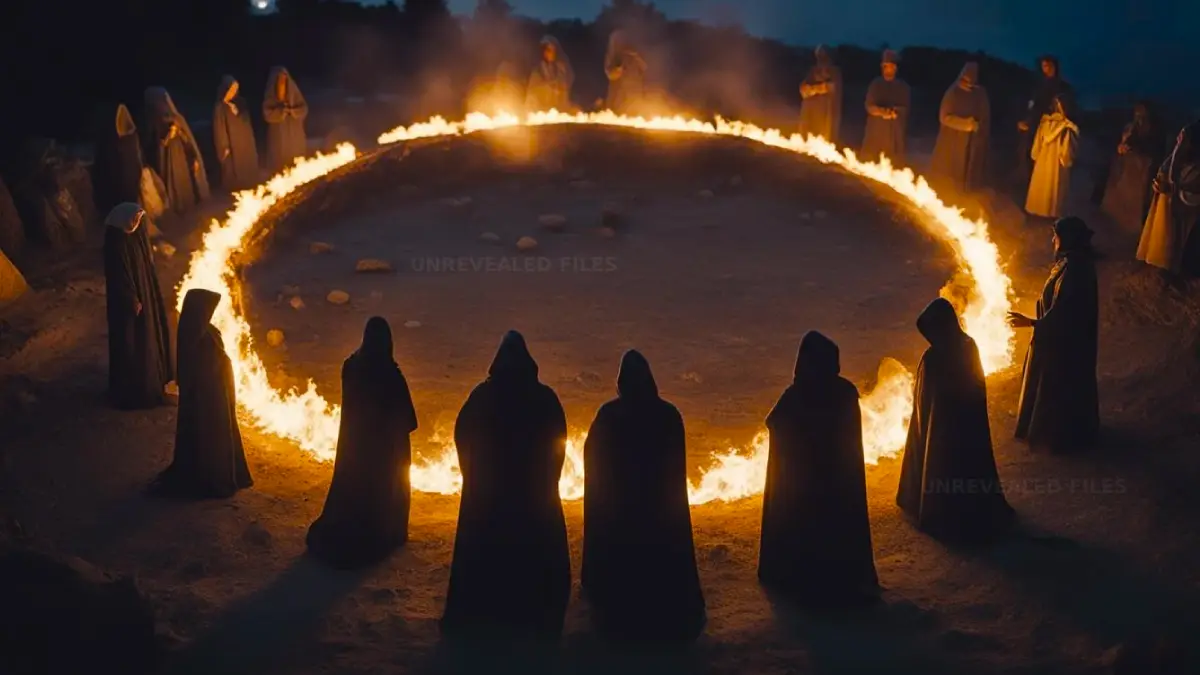
People are lighting candles for solstices. Astrology has moved from the back pages to boardrooms and dating apps. Tarot cards are discussed with the same seriousness once reserved for self-help books. Ancient gods long declared dead are returning as symbols, archetypes, and personal guides.
Paganism, in some form, is rising again.
Not as a mass conversion. Not as a rejection of science. But as a quiet cultural correction to a world that feels spiritually exhausted.
And long before TikTok, Instagram aesthetics, or “spiritual but not religious” became mainstream, popular culture planted the seed for this return. One film in particular reframed how alternative belief systems could be seen.
The Wicker Man did not start the movement, but it made it imaginable.
Paganism is often spoken about today as if it were making a comeback, an ancient religion returning to a modern world. But that framing misses the point.
What is rising is not paganism as a doctrine or a demand for belief.
What is rising is a way of looking at the world, one that modern systems failed to replace.
This return didn’t begin on social media. It didn’t begin with astrology apps or aesthetic rituals. Culturally, it became visible decades earlier, when popular culture first stopped treating paganism as primitive and started treating it as coherent.
One quiet turning point was a 1973 film: The Wicker Man.
Paganism Didn’t Come Back, It Was Never Gone

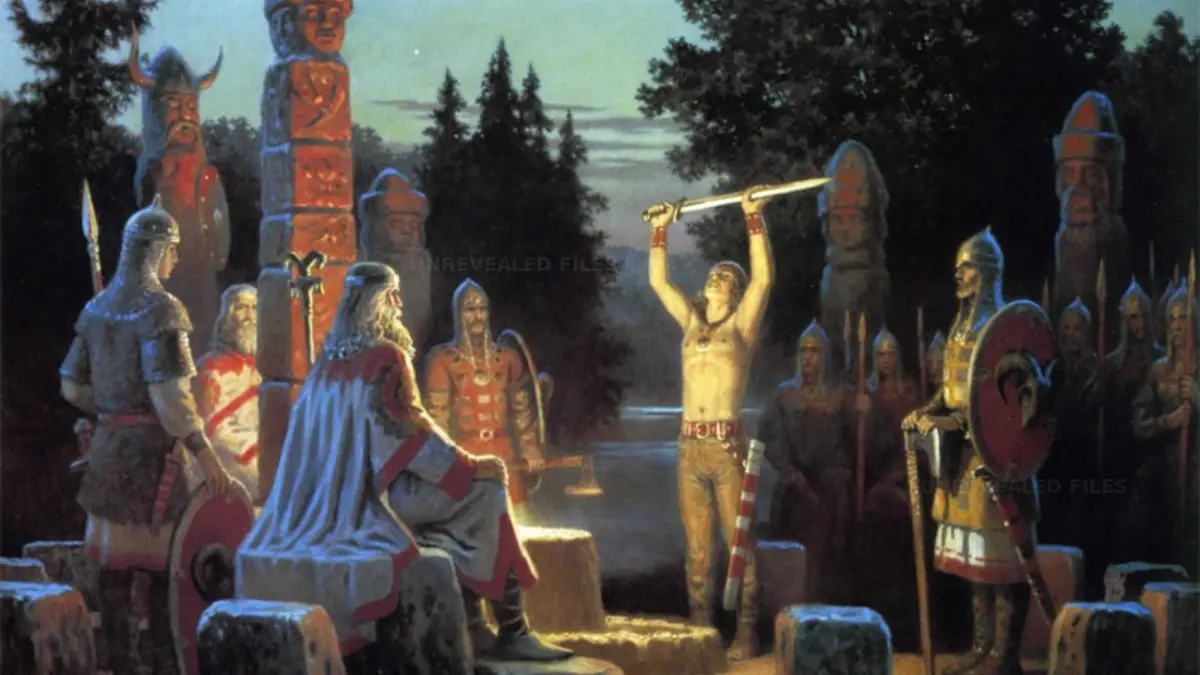
The idea that paganism vanished with the spread of organized religion is convenient, but false.
It survived in fragments:
- Harvest festivals disguised as tradition
- Seasonal rituals absorbed into “culture.”
- Folk beliefs passed down without theology
- Myths preserved in art, story, and symbol
What disappeared was permission, permission to take these beliefs seriously.
For centuries, paganism was framed as childish superstition or moral failure. The modern world inherited that bias, even as it quietly borrowed pagan ideas: cycles, nature reverence, symbolism, ritual.
The 20th century didn’t revive paganism. It removed the shame around it.
Paganism Was Never One Thing, and It Never “Spread”
Before asking whether paganism is right or wrong, or whether it spread from West to East, we need to clear a basic misunderstanding.
Paganism is not a single religion.
It is a label applied later, mostly by Christian historians, to describe local, nature-based belief systems that already existed everywhere.
Europe had its gods.
India had its rituals.
East Asia had its spirits and cycles.
Africa, the Americas, and indigenous cultures had their own cosmologies.
These traditions did not spread from one center to the rest of the world. They arose independently, shaped by land, seasons, survival, and human psychology.
What did spread from the West was the word “pagan”, and later, modern revival movements and aesthetics. The beliefs themselves were already there.
The Wicker Man and the Shift in Perspective


When The Wicker Man was released in 1973, it had a culturally disruptive impact.
It did not portray paganism as random chaos. It portrayed it as structured, ritualized, and meaningful. More importantly, it reversed the usual hierarchy.
The Christian authority figure is rigid, alienated, and disconnected.
The pagan community is cohesive, purposeful, and in tune with its environment.
This wasn’t propaganda; it was perspective.
For the first time in mainstream cinema, pagan belief wasn’t merely something to be conquered or mocked. It had its own logic. And that mattered more than whether audiences agreed with it.
Once an idea becomes imaginable, it becomes reusable.
Why Paganism Makes Sense in 2026
The renewed interest in pagan ideas is not nostalgia. It is contextual.
Modern society has optimized for efficiency, productivity, and control. What it has not optimized for is meaning.
Paganism offers what many people feel is missing:
- Decentralization
No central authority. No single truth. Belief is personal and adaptive. - Embodiment
Rituals tied to seasons, bodies, land, and time, not abstract promises. - Cycles instead of linear pressure
Life is repetition, renewal, and decay, not endless upward progress. - Participation, not submission
You don’t obey a god, you engage with forces larger than yourself.
In a world obsessed with growth metrics and optimization, paganism feels human again.
This is why modern paganism often has little to do with gods.
For many, gods are symbols, not rulers.
Rituals are grounding practices, not commands.
Belief is personal, not enforced.
Paganism today is less a religion and more an orientation, a way of relating to time, nature, and existence.
So, Is Paganism Wrong?
The question itself reveals how we’ve been taught to think.
A belief system can only be “wrong” if judged by another belief system’s rules. Paganism does not claim universal truth, final authority, or moral monopoly.
It asks different questions:
- How do cycles shape life?
- How should humans live within nature?
- How do we mark meaning in time?
Those questions are not wrong. They are ancient.
Like any worldview, paganism can be misused, turned into superstition, exclusion, or performance. But that risk exists in every system, religious or secular.
What paganism challenges is not morality; it challenges centralized certainty. Paganism isn’t wrong; it’s simply incompatible with systems that demand one truth, one authority, and one way to live. If modern systems were enough, people wouldn’t be looking backward for meaning.
This Isn’t Religion, It’s Orientation
Most modern pagans are not building temples or seeking converts.
They are:
- Marking solstices to feel grounded in time
- Using tarot or astrology as psychological mirrors
- Practicing ritual as discipline, not dogma
- Reclaiming ancestry in an increasingly rootless world
For many, gods are not literal beings. They are archetypes, ways of understanding fear, desire, death, power, and renewal.
In this sense, paganism today functions less like a religion and more like a language of meaning.
And languages spread when existing ones fail to describe reality.
The Internet Didn’t Create Paganism, It Amplified It
Social media didn’t invent the trend, but it accelerated it.
Visual ritual performs well. Symbolism compresses meaning. Myth travels faster than doctrine. Aesthetic spirituality thrives in digital spaces because it requires engagement, not belief.
That’s why pagan-adjacent content has massive reach:
- It’s personal, not institutional
- Emotional, not bureaucratic
- Ancient, yet adaptable
People aren’t rebelling against religion as much as they’re rebelling against emptiness.
What This Rise Really Reveals
The return of paganism exposes a deeper failure.
Modern systems promised fulfillment through reason, consumption, and progress. They delivered comfort but not coherence.
Paganism doesn’t promise salvation.
It doesn’t offer certainty.
It doesn’t resolve the contradiction.
It offers participation in a world that feels alive again.
That may be why it keeps returning quietly, stubbornly, across centuries.
Not because people want old gods back.
But because they want meaning that can survive modern life.
Editorial Note
This is not an argument for belief.
It’s an observation about longing.
When ancient symbols start making sense again, it’s not because the past is calling.
It’s because the present isn’t answering.
Conclusion
Paganism is rising not because people want ancient gods back, but because modern life feels spiritually empty.
Traditional institutions (religion, politics, even progress itself) no longer give many people a sense of meaning, belonging, or connection to nature and time.
The Wicker Man mattered because it was one of the first popular works to show paganism as serious and coherent, not primitive. That helped make pagan ideas culturally acceptable again.
Today, people are drawn to paganism because it offers:
- Meaning without hierarchy
- Ritual without obedience
- Cycles instead of constant pressure to “grow.”
- Connection to nature, body, and time
Modern paganism is less a religion and more a way of orienting oneself in the world using symbols, rituals, and myths to feel grounded.
In one line:
Paganism is returning because it fills a meaning gap that modern systems created but couldn’t solve.
Sources
- Adler, Margot. Drawing Down the Moon: Witches, Druids, Goddess-Worshippers, and Other Pagans in America Today. Revised ed., Penguin Books, 2006.
- Berger, Helen A. A Community of Witches: Contemporary Neo-Paganism and Witchcraft in the United States. University of South Carolina Press, 1999.
- Doyle White, Ethan. “Modern Paganism.” Encyclopaedia Britannica, Encyclopaedia Britannica, Inc., www.britannica.com/topic/modern-Paganism. Accessed 18 Jan. 2026.
- Hutton, Ronald. The Triumph of the Moon: A History of Modern Pagan Witchcraft. Oxford University Press, 1999.
- Pearson, Joanne, Richard H. Roberts, and Geoffrey Samuel, editors. Nature Religion Today: Paganism in the Modern World. Edinburgh University Press, 1998.
- Strmiska, Michael F., editor. Modern Paganism in World Cultures: Comparative Perspectives. ABC-CLIO, 2005.
- “Paganism.” Encyclopaedia Britannica, Encyclopaedia Britannica, Inc., www.britannica.com/topic/paganism. Accessed 18 Jan. 2026.
- “The Wicker Man.” Directed by Robin Hardy, starring Edward Woodward, British Lion Films, 1973.
- Harvey, Graham. Listening People, Speaking Earth: Contemporary Paganism. 2nd ed., New York University Press, 2007.
FACT CHECK: We strive for accuracy and fairness. But if you see something that doesn’t look right, don’t hesitate to Contact us.
DISCLOSURE: This Article may contain affiliate links and Sponsored ads, to know more please read our Privacy Policy.
Stay Updated: Follow our WhatsApp Channel and Telegram Channel.